Why 77% of Autonomous AI Agents Never Reach Production (2026)
Only 23% of autonomous AI agents reach production in 2026. The demo-to-production gap, why agents fail, and the playbook the winners actually use.

TL;DR
An autonomous AI agent is software that plans and executes multi-step business tasks on its own — not a chatbot that answers, but a system that acts. Getting autonomous AI agents from a demo to production is the real story of 2026.
- Building an AI agent is easy. Shipping one that runs your business is where roughly 77% of projects die. The demo-to-production gap is the real story of agentic AI in 2026 — not the model benchmarks.
- Three things kill agents in production: compounding error across long tool chains, fuzzy accountability when the agent acts on its own, and the unglamorous integration work nobody puts in a demo.
- The 23% who ship all do the same five things: pick a narrow, high-volume task; keep a human on the risky steps; scope permissions tightly; build an eval harness before scaling; and graduate from shadow mode to autonomy instead of flipping a switch.
- Proof it works when it’s bounded: Lassie raised $35M in June 2026 to run medical- and dental-practice back offices for 700+ businesses, reclaiming about 250,000 staff-hours a year.
Everyone Is Building AI Agents. Almost Nobody Is Shipping Them.
Lassie just raised $35 million to make small businesses run themselves. Andreessen Horowitz led the round in June 2026, and the pitch is exactly as ambitious as it sounds: autonomous AI agents that don’t just help a medical practice with its back office — they run it. Payment enrollment, reconciliation, insurance appeals, follow-up. The software does the work, not the staff.
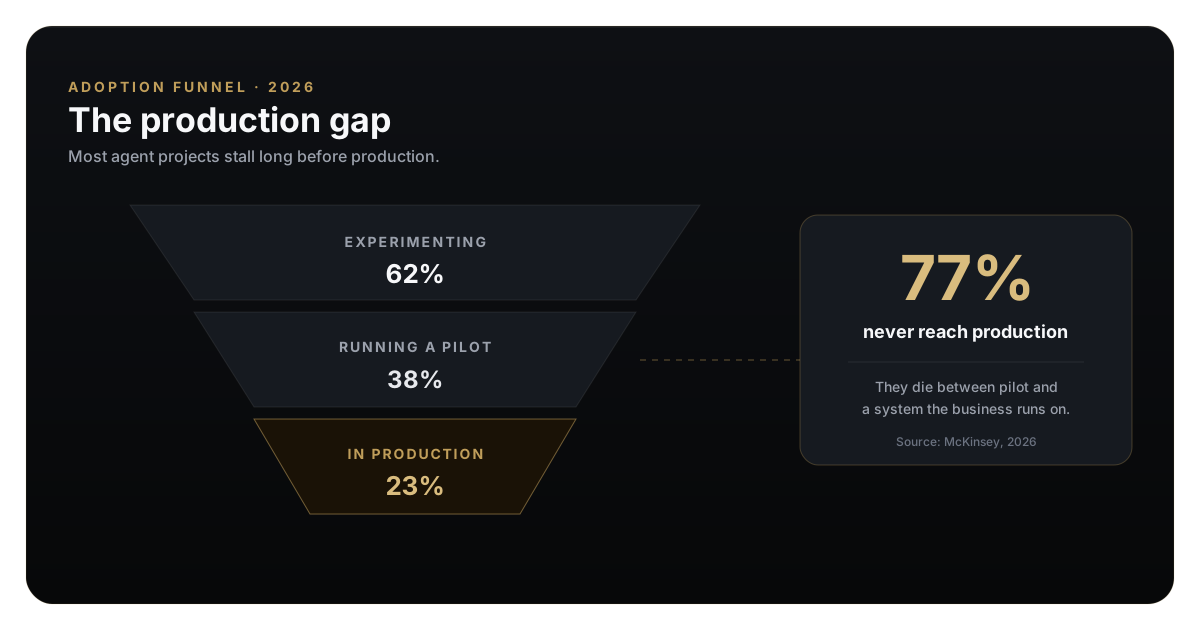
Here’s the uncomfortable part. For every Lassie, there are a hundred agent projects quietly dying in a sandbox. McKinsey’s 2026 numbers say it plainly: 62% of organizations are experimenting with agents, but only 23% have scaled them. Gartner expects 40% of enterprise apps to embed task-specific agents by the end of 2026 — up from less than 5% — which means the gap between “we built an agent” and “the business runs on it” is about to become the most expensive gap in software.
McKinsey, 2026
The survivors
That funnel is the whole article. The winners aren’t the teams with the smartest model — by 2026 everyone has access to roughly the same frontier models. The winners are the teams that treated autonomous as an outcome to earn, not a switch to flip. Let’s break down exactly where the 77% fall out, and what the survivors do differently.
What an Autonomous AI Agent That Runs the Business Actually Means
The word “agent” got stretched into meaninglessness in 2025. Half the products calling themselves agents are chatbots with a system prompt. So let’s be precise.
It helps to see it as a ladder:
- A chatbot answers questions. It has no hands.
- A copilot drafts and suggests. You review every output and you take the action.
- An autonomous agent takes the action itself — it books, files, reconciles, emails — and only escalates to a human when its own policy says to.
The jump that matters is from suggesting to acting. That single step is where reliability, trust, and accountability stop being nice-to-haves and start being the entire engineering problem. It’s also why “agentic” is not the same as “automation.” Classic automation follows a fixed script you wrote. An agent chooses the path at runtime — which is exactly what makes it powerful and exactly what makes it hard to ship.
Why This Is Suddenly Real in 2026
Agents aren’t new as an idea. What changed in 2026 is that three curves crossed at once.
Models got good enough and cheap enough. The June 2026 release wave pushed frontier capability up and token prices down hard. Reasoning that was research-grade in 2024 is now a line item.
Integration got standardized. The Model Context Protocol turned “wire the agent into your stack” from a bespoke six-week project into a connector you can reuse. Plumbing was the silent blocker, and it got a lot less silent.
The economics finally make sense for the back office. This is the part founders underrate. The money isn’t in flashy consumer demos — it’s in the boring, expensive work every small business drowns in.
The economics behind the hype
~100 hrs
Admin lost per month
Typical medical practice
$200k/yr
Spent on back-office staff
Per practice
250k hrs
Reclaimed per year
Lassie, 700+ businesses
40%
Enterprise apps with agents
Gartner, by end of 2026
Andreessen Horowitz called small businesses “the next frontier for AI” for exactly this reason: a single medical practice can burn over 100 hours a month and roughly $200,000 a year on administrative work that is repetitive, rule-bound, and perfect for an agent — if you can get the agent into production. Which brings us to the hard part.
Why 77% of AI Agents Never Reach Production
The gap is not a model problem. It’s a systems problem. Here are the five failure modes that kill agents between an impressive demo and a dependable deployment.
1. Compounding error is the silent killer
A demo runs three steps and looks like magic. Production runs twenty and falls apart. Reliability multiplies — it doesn’t average.
An agent chaining 20 tool calls at 95% per-step reliability succeeds end to end only about 36% of the time (0.95^20 ≈ 0.36). That’s not a model you can ship; that’s a coin flip you’d lose two times out of three. Push per-step reliability to a heroic 99% and you’re still only at 82% across 20 steps.
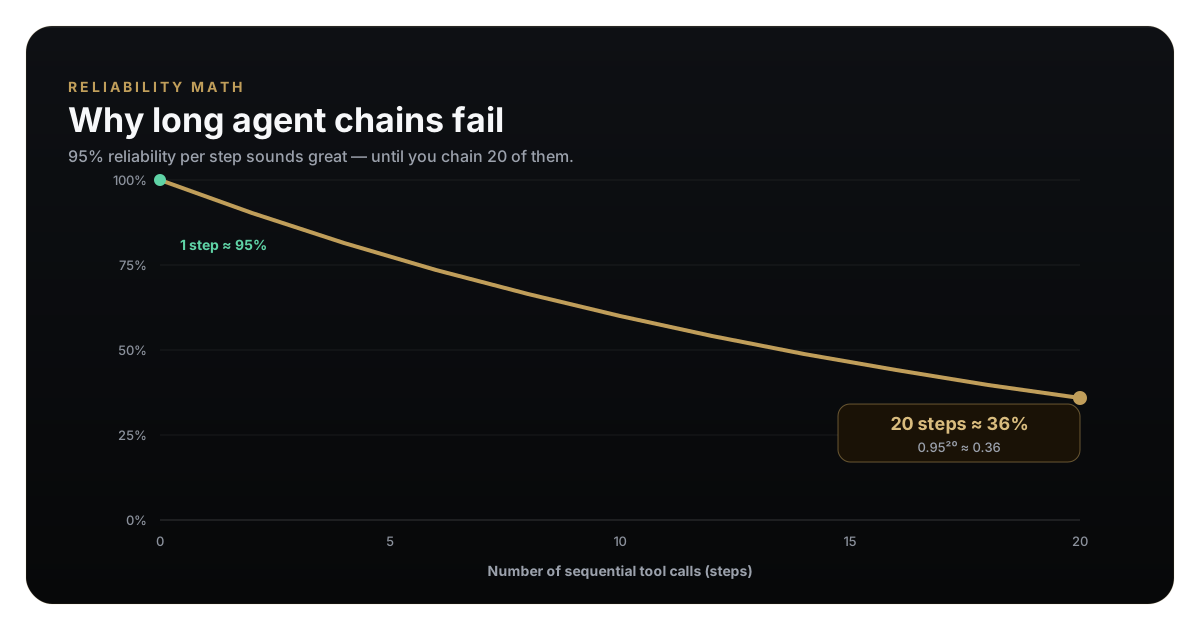
The fix is not a cleverer prompt. It’s fewer steps, verification between steps, and retries that actually check their work. The teams that ship design short, checkpointed chains. The teams that stall keep adding steps and hoping.
2. Nobody owns the outcome
When a copilot suggests something wrong, a human catches it. When an agent files the insurance appeal, posts the transaction, or emails the customer, there is no catch — unless you built one.
Demos hide this because the person demoing is the safety net. Production has to encode the safety net as policy: approval gates on irreversible actions, reversibility where you can manage it, and an audit trail for everything. “Who is accountable when the agent is wrong?” is a question you answer in your architecture, not your marketing.
3. The integration tax nobody demos
The exciting part is reasoning. The expensive part is plumbing — connecting to the practice-management system, the payment processor, the ledger, the CRM, the half-documented internal API from 2014.
Most pilots stall here. Not because the agent can’t think, but because it can’t reliably act in the messy systems a real business runs on. Standardization like the Model Context Protocol made this tractable — it did not make it trivial. Budget for the integration tax or it will quietly eat your timeline.
4. No evals, no production
If you can’t measure whether the agent did the job, you cannot ship it. Yet most teams still test by vibes: try a few prompts, it looks good, ship it.
Production needs an eval harness — a labeled set of real tasks, an automated grader, and a single number you can watch move as you change things. This is the same discipline behind spec-driven development: write down what “done” means before you trust a machine to do it. No harness, no honest answer to “is it good enough yet?”
5. Cost and latency at scale
A run that costs $0.40 and takes 90 seconds is delightful in a demo and brutal at 50,000 runs a day. The unit economics of the agent loop — tokens, retries, tool round-trips — decide whether the pilot survives contact with real volume.
💡 Key insight: The teams that ship treat reliability as an engineering budget to spend, not a model property to wait for.
What the 23% Do Differently
The survivors are almost boring about it. They don’t chase the most autonomous agent they can build — they build the most bounded agent that solves a real problem, then earn autonomy from there.
The production playbook
What separates the 23% who ship from the 77% who stall.
STEP 01
Pick a narrow, high-volume, bounded task
Not "run my company." One repetitive workflow with a clear definition of done and obvious success criteria.
STEP 02
Put a human at the right checkpoint
Approval gates on irreversible or high-stakes actions; full autonomy on the cheap, reversible ones. Spend human attention where it actually buys safety.
STEP 03
Wrap deterministic guardrails and scoped permissions
Least-privilege tool access. The agent can only touch what this task needs — nothing more.
STEP 04
Build an eval harness before you scale
No evals, no production. Measure task success on real cases, not vibes on demo cases.
STEP 05
Run in shadow mode, then graduate
Observe the agent in parallel with humans, prove reliability on real volume, then hand over autonomy gradually.
Why this step existsThis is the path from a demo to something dependable.
Notice what’s missing: “use a bigger model.” Model choice matters, but it’s table stakes. The differentiator is operating discipline.
The Autonomy Spectrum: It’s a Dial, Not a Switch
The biggest framing mistake teams make is treating autonomy as binary — either the human does it or the agent does. In reality it’s a spectrum, and the credible 2026 deployments cluster in the middle.
| Level | What the agent does | Human role | 2026 reality |
|---|---|---|---|
| L0 Assist | Answers, drafts | Does everything | Ubiquitous |
| L1 Suggest | Proposes actions | Approves each one | Common |
| L2 Execute with approval | Acts once approved | Gatekeeper | Where shipping happens |
| L3 Supervised autonomy | Acts, flags exceptions | Monitors | Leading edge |
| L4 Full autonomy | Acts unsupervised | None | Mostly demos |
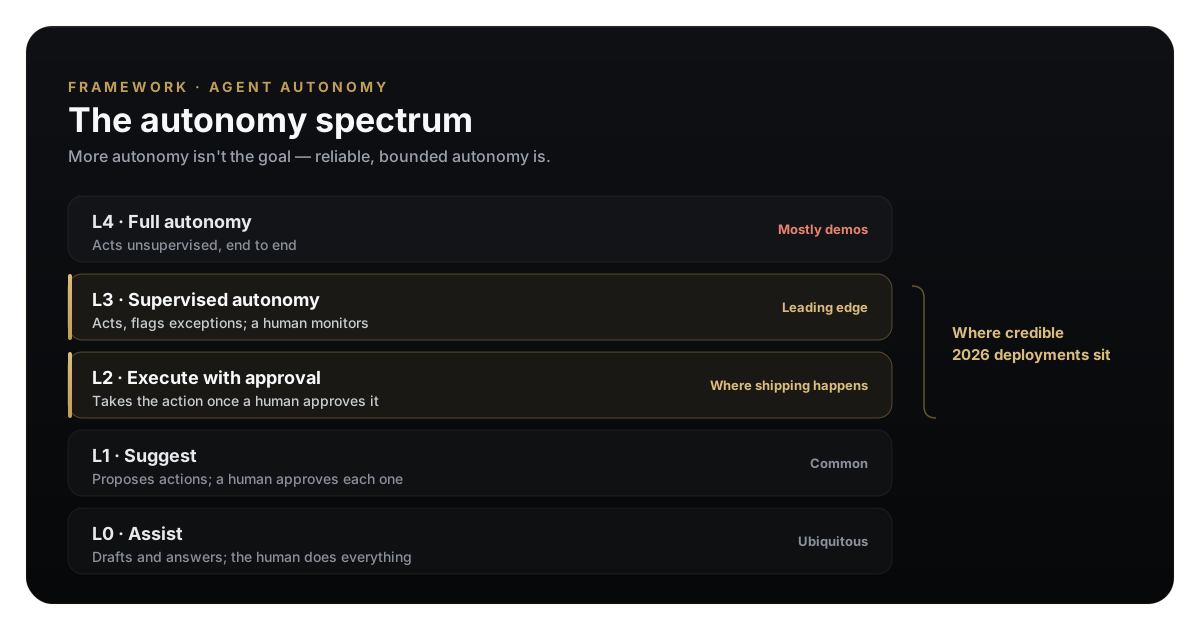
L4 makes the headlines and the funding decks. L2 and L3 make the money. A supervised agent that handles 90% of cases autonomously and escalates the weird 10% to a human is worth far more than a fully autonomous agent that’s right 70% of the time and unaccountable for the other 30%. Earn your way up the ladder; don’t start at the top.
The Mistakes That Keep Teams Stuck
- The “run my whole company” fantasy. Broad, open-ended scope is undemoable and unshippable. Narrow until the task is boring, then ship the boring version.
- Demo-driven development. Optimizing for the three-step happy path that looks great on stage and ignores the long tail that breaks in production.
- Over-permissioned agents. Handing the agent god-mode credentials “to move fast.” You’re one prompt injection away from regret. Scope everything.
- Skipping evals. Without a number, “good enough” is a feeling, and feelings don’t survive a board meeting after the agent fails publicly.
- Ignoring the integration tax. Treating the messy back-office plumbing as an afterthought, then discovering it is the project.
Case Study: How Lassie Actually Ships Autonomy
Lassie is a useful case study precisely because it isn’t trying to do everything. It picked one vertical with a brutal admin burden and went deep.
Why Lassie's design actually ships
BOUNDED SCOPE
One vertical, one job
Medical and dental back office — payment enrollment, reconciliation, appeals, reporting.
HIGH VOLUME
Repetitive and measurable
The tasks recur daily and have a clear definition of done, so reliability is testable.
TRACTION
Real deployments
700+ businesses; $35M Series A led by a16z; $47M total raised.
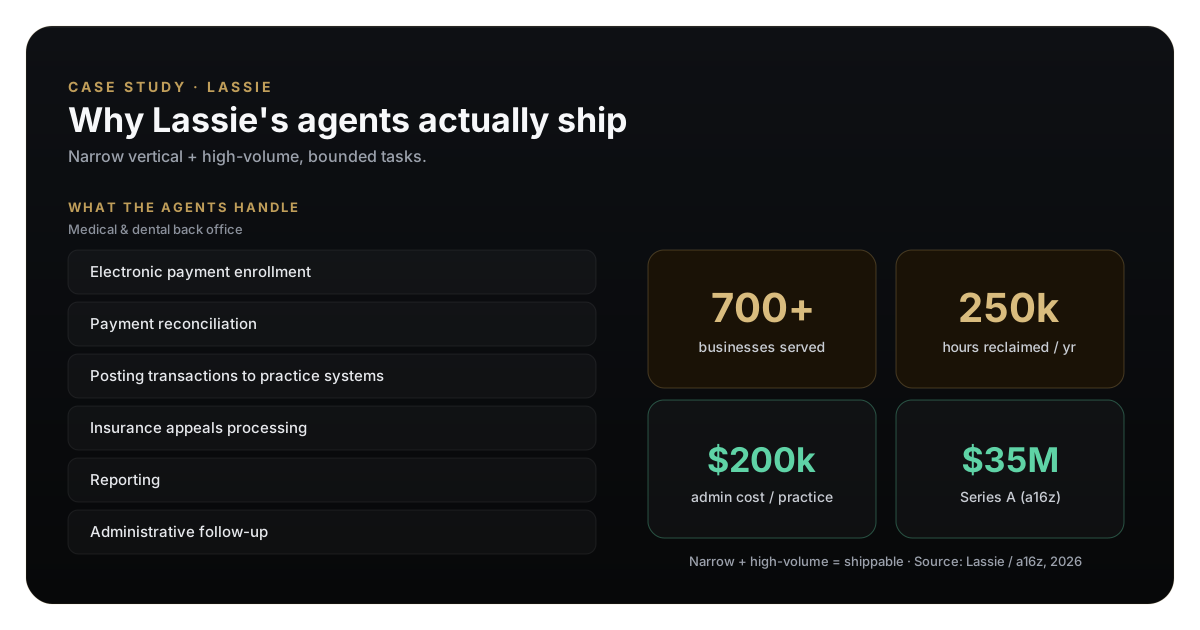
The lesson isn’t “build a Lassie.” It’s that their design choices are the production playbook in disguise: a narrow vertical (bounded scope), high-volume repetitive tasks (testable reliability), and a workflow with clear success criteria (eval-friendly). They didn’t win by being more autonomous than everyone else. They won by being autonomous about the right, small thing — and being able to prove it worked.
Is Your Agent Actually Production-Ready?
Before you let an agent touch anything a customer or a regulator will see, run this checklist. If you can’t tick the criticals, you have a demo, not a deployment.
Production-readiness checklist
Track progress as you work through the list
0%
0/7 done
FAQ
Questions readers usually have
The Bottom Line
In 2026, building an autonomous AI agent is a weekend project. Building one your business can actually run on is a discipline — and it’s a discipline most teams skip on the way to a demo that wins applause and a deployment that never arrives.
Stop trying to flip the autonomy switch. Pick one narrow, high-volume, boring task. Put a human on the dangerous steps. Scope the permissions. Build the eval harness. Run it in the shadows until the numbers earn your trust — then, and only then, let it act on its own. That’s how the 23% ship while everyone else demos.
If this was useful, read how agentic AI breaks the enterprise security model next — because the moment your agent can act, security stops being optional. Then learn to build the integration layer with MCP and to pin down “done” with spec-driven development.
Written for umesh-malik.com — no-fluff technical writing on AI, Web Dev, and Engineering.
SEO Summary (unpublished)
- Suggested slug: /blog/autonomous-ai-agents-production-gap-2026
- Meta description: Everyone’s building autonomous AI agents in 2026 — but only 23% reach production. The demo-to-production gap, why agents fail, and the playbook the winners use.
- Primary keyword: autonomous AI agents 2026
- Secondary keywords: AI agents for business, AI agents in production, agentic AI 2026, why AI agents fail, human-in-the-loop agents, vertical AI agents, AI agent reliability
- GEO hooks: “What an Autonomous AI Agent That Runs the Business Actually Means”, “Why 77% of AI Agents Never Reach Production”, “What the 23% Do Differently”
- Internal links: agentic-ai-enterprise-security-model, how-to-build-mcp-server, spec-driven-development-ai-agents-addy-osmani
- Featured snippet opportunity: Y — the autonomy spectrum table and the “Why 77% never reach production” list
Google Search · Preferred sources
Prefer this site on Google
If you already read this writing, add umesh-malik.com as a Preferred Source. Google can then highlight it with a preferred badge in Top Stories, AI Overviews, and AI Mode — for you, not as a site-wide ranking boost.
Related Articles

AI Engineering
How to Ground AI Agent Findings in Evidence: A Cloudflare Pattern
How to ground AI agent findings in evidence: validate every citation in code. Cloudflare's 3-state pattern plus a TypeScript checker you can copy.

AI Engineering
Agent context compaction: keep what the 150K cutoff drops
Agent context compaction drops every block before the summary at 150K tokens. What survives, what instructions silently replaces, and the usage field that lies.

AI Engineering
Agent Harness Design: Why an ARC-AGI-3 Score Tripled
Agent harness design decided a benchmark: OpenAI's ARC-AGI-3 score went 13.3% → 38.3% with zero model changes. What that means for your agent loop.
Keep reading
Get new posts on AI, Claude Code & LLMs
New deep-dives on AI engineering, Claude Code, and developer tooling — follow along however you prefer.
About the Author

Software engineer writing about AI, Claude Code, LLMs, OpenAI, Anthropic, and developer tooling. 5+ years building production systems at Expedia Group, Tekion, and BYJU'S.