SvelteKit vs Next.js 2026: Which Should You Choose?
SvelteKit vs Next.js: an in-depth 2026 comparison of performance, DX, routing, and deployment, from real production experience.

Having built production applications with both, I’ve settled the SvelteKit vs Next.js question the only way that matters: by shipping real products and watching what breaks. This is an honest, experience-based comparison, not a spec-sheet rundown. Whichever you choose, the same fundamentals carry over — see my React performance techniques and Core Web Vitals optimization guide. See also The $1,100 Framework That Just Made Vercel’s $3 Billion Moat Obsolete.
What Is SvelteKit vs Next.js, Really?
SvelteKit is a compiler-first meta-framework that turns .svelte components into vanilla JavaScript at build time; Next.js is a React meta-framework that ships the React runtime and renders via Server Components and the App Router. That one distinction — compile-away vs. runtime-included — explains almost every difference below.
TL;DR
- Bundle size: SvelteKit ships less JavaScript because there’s no framework runtime to send to the browser.
- Learning curve: SvelteKit’s runes (
$state,$derived) are easier to pick up than React hooks and their dependency-array footguns. - Ecosystem: Next.js wins on raw library count, hiring pool, and Stack Overflow answers — React’s gravity is real.
- Data fetching: SvelteKit’s
loadfunctions are simpler to reason about than Next.js’s mix of Server Components,fetchcaching, and Server Actions. - Verdict: greenfield + small/medium team → SvelteKit. Existing React estate + enterprise scale → Next.js.
THE DECISION IN ONE SCREEN
This comparison is not about declaring a universal winner. It is about matching the framework to the team, the existing ecosystem, and the product constraints.
PERFORMANCE
SvelteKit tends to win on shipped JavaScript and simplicity
Compiling components away gives SvelteKit a structural advantage for leaner bundles and a smaller mental model.
- Smaller client payloads
- Straightforward reactivity
- Less framework overhead by default
ECOSYSTEM
Next.js still wins on market gravity
If your team, hiring pipeline, and component investment are already React-heavy, Next.js lowers switching friction.
- Larger library ecosystem
- More documentation and examples
- Broader hiring familiarity
DX
SvelteKit often feels cleaner for greenfield work
Routing, layouts, and load functions are explicit and easier to reason about, especially for smaller teams moving quickly.
- Consistent file conventions
- Simpler data-loading model
- Less ceremony for common tasks
ENTERPRISE FIT
Next.js is safer when React is already your platform
The “best” framework is often the one that compounds what the organization already knows instead of forcing a platform reset.
- Reuse React component libraries
- Fit into existing frontend standards
- Reduce migration overhead
SvelteKit vs Next.js: Feature-by-Feature Table
Here’s the comparison in one place, before the detailed breakdown below.
| Dimension | SvelteKit | Next.js |
|---|---|---|
| Rendering model | Compiles components to vanilla JS at build time | Ships the React runtime; renders via Server/Client Components |
| Typical client bundle | Smaller — no framework runtime shipped | Larger — React + reconciler included |
| Learning curve | Gentler; runes read like plain JavaScript | Steeper; hooks, dependency arrays, Server/Client boundary |
| Routing | File-based, +page.svelte / +layout.svelte | File-based, App Router, page.tsx / layout.tsx |
| Data fetching | load functions in +page.server.ts, explicit and typed | Server Components, fetch caching, Server Actions |
| Ecosystem size | Smaller, growing fast | Massive — the entire React library ecosystem |
| Deployment targets | Adapter system (adapter-cloudflare, adapter-node, adapter-vercel, adapter-static) | Vercel-native, also Cloudflare, Node, Docker |
| Best fit | Greenfield, content-heavy, performance-sensitive products | Teams already invested in React at scale |
Bundle Size & Performance
SvelteKit compiles your components to vanilla JavaScript at build time, resulting in significantly smaller bundles. Next.js ships the React runtime, which adds to the initial bundle size — even a “hello world” Next.js page sends more JavaScript than the equivalent SvelteKit page, because React itself has to be on the wire before your code runs.
In practice, that gap shows up most on slower connections and mid-range mobile devices, where parse/execute time on the main thread matters as much as download size. The Next.js documentation itself recommends aggressive code-splitting and dynamic imports to claw back what SvelteKit gets by default.
Winner: SvelteKit for initial bundle size.
Developer Experience
SvelteKit’s file-based routing is clean and predictable. Svelte’s reactivity model with runes ($state, $derived) is more intuitive than React’s hooks — there’s no dependency array to get wrong, no useMemo/useCallback ceremony to remember, and no rules-of-hooks linter yelling at you for writing a conditional.
New engineers on my teams have picked up Svelte’s mental model in an afternoon. React’s hooks — especially useEffect — take longer to use correctly, and stale-closure bugs still show up in senior developers’ PRs.
Next.js has the advantage of the massive React ecosystem and extensive documentation. If your team already thinks in React, that familiarity is worth real velocity on day one, even if the long-run authoring experience is more verbose.
Winner: Tie — depends on team familiarity.
Data Fetching
SvelteKit uses load functions in +page.server.ts files. It’s explicit and type-safe — and if you lean on TypeScript utility types like Pick and Partial, the load return types compose cleanly.
// SvelteKit
export const load: PageServerLoad = async ({ params }) => {
  const post = await getPost(params.slug);
  return { post };
};
Next.js uses Server Components and a wider surface of fetching patterns: fetch with its own caching semantics, Route Handlers, and Server Actions for mutations. The Next.js data fetching docs cover all three, and picking the right one for a given screen is a real decision every time — SvelteKit collapses that decision into one convention.
That said, Server Actions are genuinely convenient for form mutations once you’ve internalized the model — it’s not that Next.js’s approach is worse, it’s that it hands you more knobs than most teams need on day one.
Winner: SvelteKit for simplicity.
Routing
Both use file-based routing. SvelteKit uses +page.svelte convention while Next.js uses the App Router with page.tsx.
SvelteKit’s layout system with +layout.svelte is cleaner than Next.js’s nested layouts.
Winner: SvelteKit for consistency.
Ecosystem & Community
Next.js has a larger ecosystem, more third-party libraries, and more learning resources. React’s component library ecosystem is unmatched — component libraries, form libraries, state managers, testing tools, and AI SDKs almost always ship a React integration first, Svelte second (if at all).
That gap is closing — Svelte’s npm downloads and community have grown steadily each year — but for now, if you need a specific niche React library with no Svelte equivalent, that alone can decide the framework choice for you.
Winner: Next.js for ecosystem size.
Deployment
Both deploy easily to Vercel, Cloudflare, and other platforms. SvelteKit’s adapter system is elegant — swap adapter-cloudflare for adapter-node and you’re done.
Winner: Tie
When to Choose SvelteKit
- New projects where you control the tech stack
- Performance-critical applications
- Small to medium teams
- Content-heavy sites and blogs
- Projects that benefit from smaller bundles
When to Choose Next.js
- Teams already proficient in React
- Projects needing extensive third-party React libraries
- Enterprise applications requiring the React ecosystem
- Projects with existing React component libraries
GREENFIELD VS EXISTING REACT ESTATE
The practical decision usually comes down to whether you are starting clean or extending an already-large React investment.
CHOOSE SVELTEKIT
Best when you can optimize for the product, not the org chart
- New project with freedom to pick the best DX/performance trade-off
- Content-heavy or performance-sensitive product
- Small to medium team that values speed and simplicity
- You want less framework ceremony and a gentler learning curve
CHOOSE NEXT.JS
Best when the React ecosystem is already your leverage
- Team already ships React at scale
- Existing design system and component library are React-native
- Third-party dependencies strongly assume React
- Migration cost would outweigh the framework-level gains
My Recommendation
For new projects, I’d recommend SvelteKit if your team is open to learning Svelte. The developer experience is superior, the performance is better out of the box, and the learning curve is gentler.
For teams invested in React, Next.js remains the best choice in the React ecosystem.
Both are excellent frameworks, and you won’t go wrong with either — the SvelteKit vs Next.js decision is about fit, not quality.
FAQ
Questions readers usually have
Sources
- SvelteKit documentation — official docs on routing,
loadfunctions, and adapters. - Next.js documentation — Data Fetching — Server Components, caching, and Server Actions.
- Next.js documentation — Optimizing — code-splitting and bundle-size guidance referenced above.
Google Search · Preferred sources
Prefer this site on Google
If you already read this writing, add umesh-malik.com as a Preferred Source. Google can then highlight it with a preferred badge in Top Stories, AI Overviews, and AI Mode — for you, not as a site-wide ranking boost.
Related Articles
Web Engineering
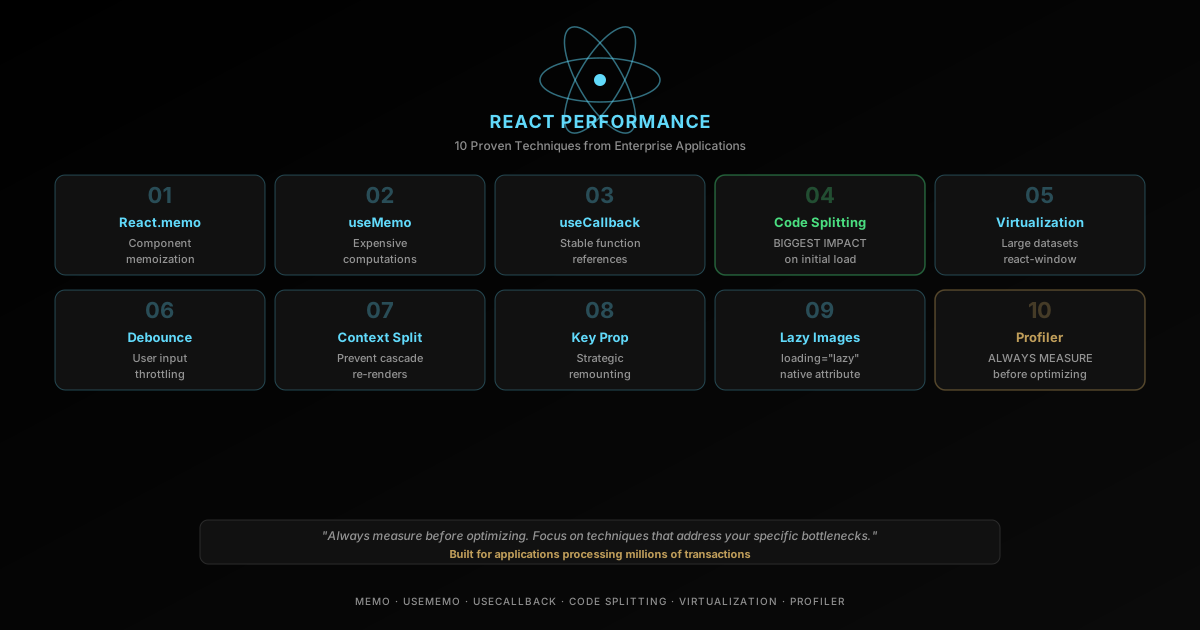
React Performance Optimization: 10 Proven Techniques
React performance optimization techniques — memoization, code splitting, virtualization, and 7 more battle-tested strategies from real apps.

Web Engineering
Fix Shadow DOM innerHTML not working: use setHTMLUnsafe
Shadow DOM innerHTML not working is a parsing gap, not a bug — it silently skips declarative shadow roots. Use setHTMLUnsafe() instead, plus five more gotchas.

Web Engineering
Build JavaScript Proxy Reactive State: 855 Bytes, No Framework
Javascript proxy reactive state in under a kilobyte: an 80-line get/set trap that tracks reads, batches writes, and quietly breaks on one property name.
Keep reading
Get new posts on AI, Claude Code & LLMs
New deep-dives on AI engineering, Claude Code, and developer tooling — follow along however you prefer.
About the Author

Software engineer writing about AI, Claude Code, LLMs, OpenAI, Anthropic, and developer tooling. 5+ years building production systems at Expedia Group, Tekion, and BYJU'S.