ChatGPT Interactive Math and Science Visuals: What to Know
ChatGPT interactive math and science visuals launched in March 2026: how the new learning modules work, who gets access, and why students benefit.
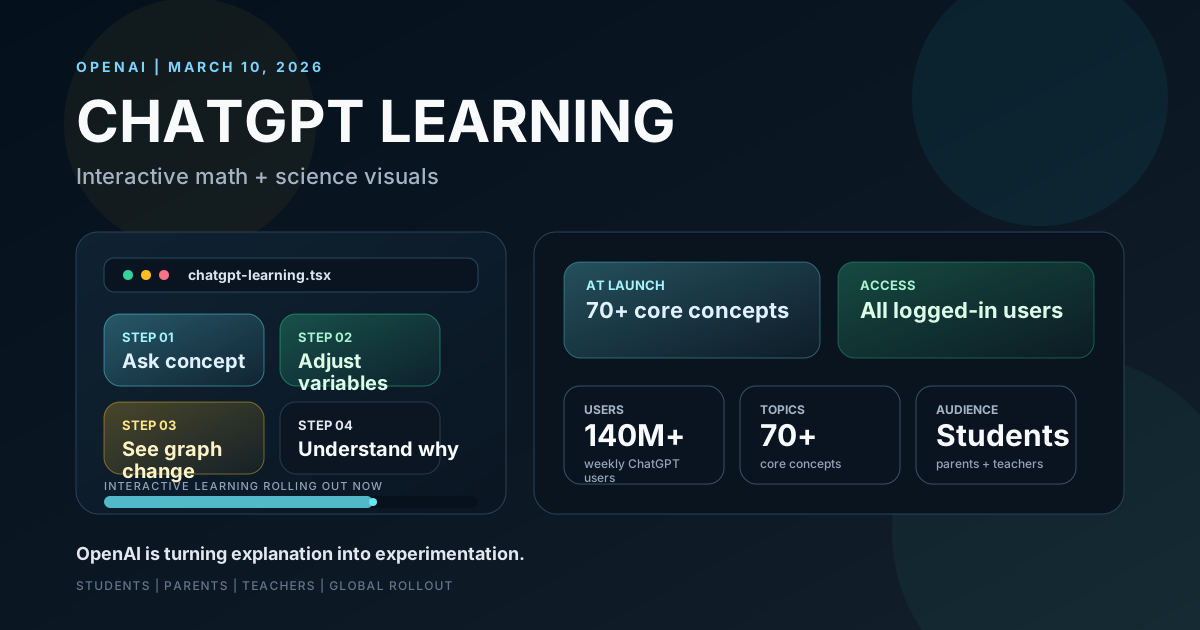
OpenAI launched ChatGPT interactive math and science visuals on March 10, 2026, and this is exactly the kind of AI update that normal people will care about immediately. See also ChatGPT “Adult Mode”.
A ChatGPT interactive math and science visual is an on-demand diagram you can manipulate: change one variable, like slope or pressure, and watch the concept respond live instead of reading a static paragraph about it.
Not because it wins another benchmark. Not because it adds a new model name. But because it changes one of the most common real-world uses of ChatGPT: trying to understand something hard.
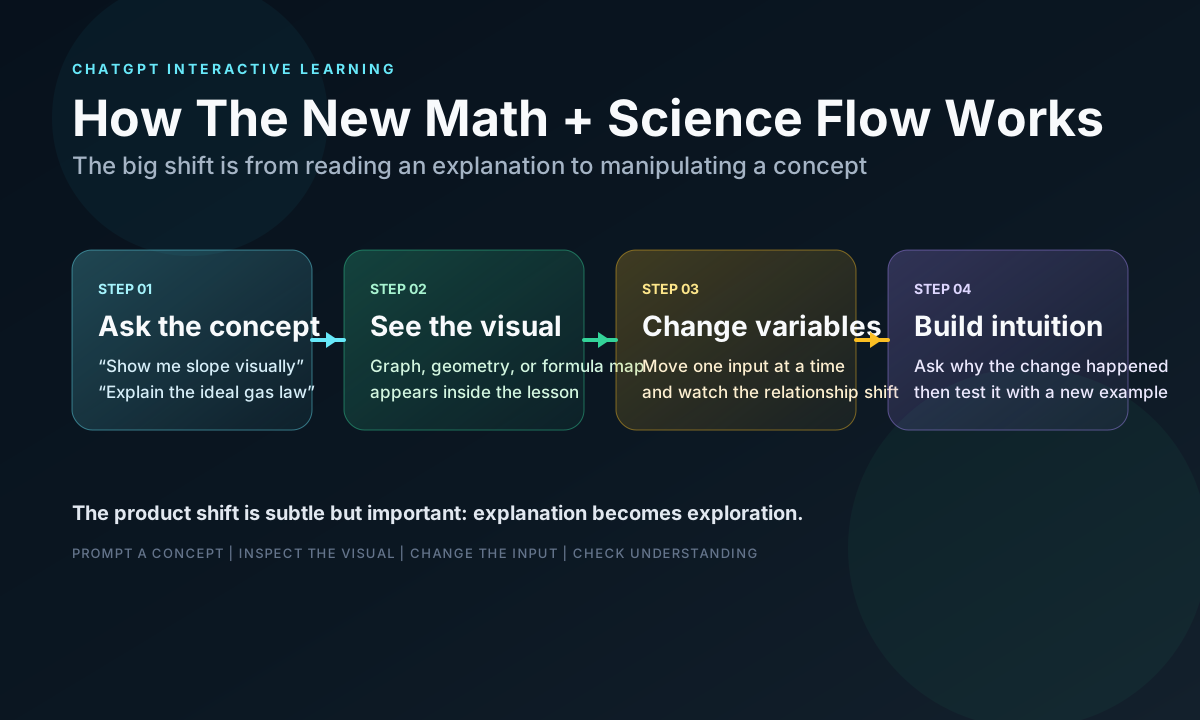
The short answer is simple: ChatGPT is moving from “explaining a concept” to “letting you explore a concept.” Instead of only reading a paragraph about slope, pressure, or the Pythagorean theorem, users can now manipulate variables, see relationships update, and build intuition visually.
That matters everywhere, but it is especially relevant in the United States. Gallup found that 60% of U.S. adults feel challenged by doing math, and parents who feel better about math are far more confident helping their children with it. At the same time, OpenAI already has a free ChatGPT for Teachers plan for verified U.S. K-12 educators through June 2027. So this is not just a product update. It is an education-distribution story with a clear U.S. audience from day one.
CHATGPT LEARNING VISUALS AT A GLANCE
140M+
Weekly Users
use ChatGPT for math and science
70+
Core Concepts
supported at launch
All Plans
Rollout
for logged-in users
June 2027
U.S. Teachers
free K-12 access plan
START WITH THE PART THAT MATCHES YOUR ROLE
This story is bigger than an AI feature launch. It lands differently if you are a student, a parent, or an educator trying to support learning.
Use this to skip to what matters
STUDENTS
You want to know if this will actually help you learn
Start with what OpenAI launched, then jump to the try-it-tonight section and the topic map.
Focus on
OutcomeYou will know how to use the feature for understanding, not just answer-getting.
U.S. PARENTS
You want to know whether this can reduce homework stress
Read the public-interest angle, the U.S. context, and the limitations section together.
Focus on
OutcomeYou will leave with a cleaner sense of when ChatGPT can help and when it should not be trusted alone.
TEACHERS
You want the classroom and workflow angle
Jump to the OpenAI education timeline, access section, and the section on where this fits beside teaching.
Focus on
OutcomeYou will see how this feature fits into the broader OpenAI education stack, especially in the U.S.
TL;DR
OpenAI launched interactive math and science visuals in ChatGPT on March 10, 2026.
OpenAI says more than 140 million people already use ChatGPT for math and science each week.
The feature starts with 70+ core concepts and lets users interact with ideas visually instead of only reading text explanations.
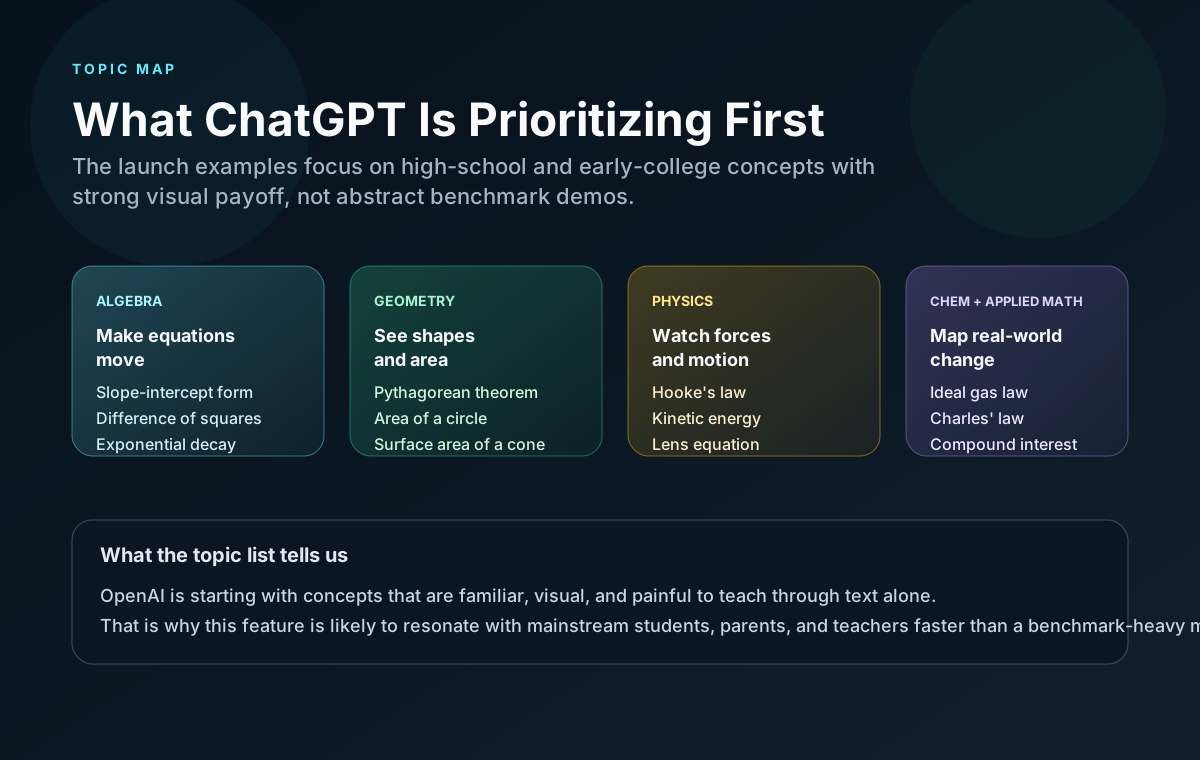
OpenAI’s examples include topics like the Pythagorean theorem, slope-intercept form, ideal gas law, Charles’ law, Hooke’s law, kinetic energy, lens equation, compound interest, and exponential decay.
As of March 12, 2026, OpenAI says rollout is going to all logged-in ChatGPT users across plans.
This is especially relevant in the U.S., where Gallup found 60% of adults feel challenged by math and OpenAI already offers ChatGPT for Teachers free through June 2027 for verified U.S. K-12 educators.
The biggest shift is conceptual: ChatGPT is becoming more exploratory and less purely answer-based.
The biggest limitation is also obvious: interactive visuals do not remove the need for teachers, verification, or real understanding.
What Is ChatGPT Interactive Math and Science, Actually?
The official OpenAI framing is straightforward.
ChatGPT can now generate interactive learning visuals for math and science topics. Instead of explaining everything in static text, the product can show relationships visually and let the learner change inputs to see what happens.
That sounds simple, but it changes the experience in an important way:
- text answers tell you what a concept is
- interactive visuals help you feel how a concept behaves
For learning, that difference is huge.
If a student changes the slope in a line equation and sees the line rotate, or changes pressure and temperature in a gas law example and watches the relationship update, the concept stops being just another memorized statement. It becomes something they can inspect.
WHAT THE NEW EXPERIENCE DOES
This release matters because it makes ChatGPT more useful for concept learning, not just for homework completion.
VISUAL LEARNING
Turns abstract formulas into something you can manipulate
The user can move beyond static explanations and explore how variables affect a system.
- Watch relationships update
- Build intuition visually
- See cause and effect faster
BREADTH
Launches with 70+ core topics
OpenAI is starting with high-frequency math and science concepts rather than niche edge cases.
- School-relevant topics
- High-school and early-college friendly
- Broad public usefulness
ACCESS
Not locked to an expensive niche plan
OpenAI says the rollout is going to all logged-in users, which makes this a mainstream product story, not just a power-user story.
- Free and paid users
- Global logged-in rollout
- Low friction for mainstream adoption
LEARNING DESIGN
Pushes ChatGPT closer to exploration than answer dumping
This release works best when it helps users inspect a concept instead of just copy an output.
- Concept-first learning
- Better for intuition
- More useful for follow-up questions
Why This Story Is Bigger in the U.S.
This is where the audience targeting matters.
If you write this as generic AI product news, it looks like another feature release. If you write it from the perspective of the people most likely to care, it becomes much more interesting:
- students who already use ChatGPT for homework and test prep
- parents trying to help with math or science at home
- teachers deciding what productive AI use should actually look like
The U.S. angle is especially strong for two reasons.
First, Gallup found that 60% of U.S. adults feel challenged by doing math, and parents with more positive math feelings are much more confident helping their children. That means a tool that can make concepts clearer is not just a student story. It is a family story.
Second, OpenAI has already built a specific U.S. education distribution path. In November 2025, it launched ChatGPT for Teachers, free through June 2027 for verified U.S. K-12 educators. That means the new student-facing visual layer and the U.S.-teacher product story now reinforce each other.
This is why the launch has real mainstream-read potential. It is AI, but it is also:
- homework help
- parent confidence
- classroom workflow
- education anxiety
- a familiar consumer product people already use
That combination is stronger than a typical model release.
-
July 29, 2025
Study mode launches in ChatGPT
OpenAI introduces step-by-step learning guidance instead of immediate answer-first behavior.
-
November 19, 2025
ChatGPT for Teachers launches
OpenAI makes a secure teacher-focused workspace free for verified U.S. K-12 educators through June 2027.
-
March 10, 2026
Interactive math and science visuals launch
ChatGPT moves from static explanation into visual, interactive concept exploration across 70+ topics.
OpenAI’s Education Stack Is Getting Clearer
The easiest way to understand this launch is to stop treating it as a random feature and start treating it as another layer in OpenAI’s education strategy.
| Layer | What it does | Who it helps most |
|---|---|---|
| Standard ChatGPT | Fast answers and general explanation | Everyday users |
| Study mode | Step-by-step guidance instead of answer dumping | Students working through homework or exam prep |
| Interactive visuals | Visual exploration of math and science concepts | Students, parents, and anyone trying to build intuition |
| ChatGPT for Teachers | Secure educator workspace with school-friendly controls | Verified U.S. K-12 teachers and school staff |
That stack makes strategic sense.
- study mode helps with pedagogy
- interactive visuals help with conceptual intuition
- teacher workspaces help with real classroom adoption
Individually, each feature is useful. Together, they suggest OpenAI is serious about being part of the learning workflow, not just a generic chatbot students occasionally visit.
What Topics Matter Most at Launch
OpenAI’s examples are revealing.
This is not a launch built around obscure graduate-level edge cases. The emphasis is on concepts that are:
- common in school
- visually teachable
- painful to explain with text alone
- familiar enough that parents and teachers immediately understand the value
Examples OpenAI highlighted include:
- Pythagorean theorem
- slope-intercept form
- difference of squares
- area of a circle
- surface area of a cone
- ideal gas law
- Charles’ law
- Coulomb’s law
- Hooke’s law
- kinetic energy
- lens equation
- compound interest
- exponential decay
That list is the real clue.
OpenAI is not trying to start with “everything.” It is starting with concepts that sit at the intersection of:
- high student demand
- high parent-recognition value
- strong visual payoff
- clear classroom relevance
How To Get the Most Useful Experience Tonight
Most people will get more value from this feature if they use it like a learning tool, not like a shortcut machine.
BEST WAY TO TRY IT
The quickest path to a useful first experience is to ask for one concept, one visual, and one variable change at a time.
START SIMPLE
Pick one concept you actually find confusing
Do not begin with a huge worksheet. Start with one topic like slope, exponential decay, or the ideal gas law.
- Ask for one visual explanation
- Keep the first prompt narrow
- Prioritize a concept you already struggle with
Why this step existsThe interaction stays focused enough to build intuition instead of becoming a generic tutoring blob.
MAKE IT MOVE
Ask ChatGPT to change one variable at a time
The value of the new feature is in seeing how a system changes, not just in getting one static answer.
- Increase one input
- Decrease one input
- Ask what relationship is changing and why
Why this step existsYou turn the lesson from passive reading into active exploration.
LINK INTUITION TO FORMULA
Ask for both the plain-English reason and the equation
Students often memorize formulas without understanding what they mean physically or geometrically.
- Ask what the formula is saying
- Ask what the graph means
- Ask for a real-world analogy
Why this step existsThe concept becomes easier to remember because it has both a visual model and a verbal one.
CHECK UNDERSTANDING
Finish with a practice question or a teach-it-back prompt
Understanding is not the same as recognizing a graphic. End by explaining the idea back or solving a nearby problem.
- Ask for a short quiz
- Explain the concept back
- Try one related example
Why this step existsYou verify that the visual actually improved understanding instead of just looking impressive.
PROMPTS TO TRY TONIGHT
Track progress as you work through the list
0%
0/6 done
Where This Still Falls Short
This launch is strong, but the wrong expectations will ruin it.
BEST CASE VS LIMITS
The most useful reading is the one that keeps both the upside and the constraint case in view.
BEST CASE
Why this can become genuinely useful for mainstream learning
Concepts like slope, pressure, force, and growth are easier to understand when you can see relationships move instead of only reading descriptions.
- Reduces friction for first-pass understanding
- Helps students who learn visually
- Can make parents more confident helping with homework
- Fits naturally into teacher demonstrations and explanation workflows
LIMITS
Why it still does not replace teachers, textbooks, or verification
Interactive visuals improve comprehension, but they do not eliminate mistakes or guarantee durable understanding.
- Coverage begins with 70+ topics, not everything
- ChatGPT can still oversimplify or be wrong
- Strong visuals do not automatically mean strong pedagogy
- Students still need practice, proof, and feedback beyond the visual
The biggest mistake would be to frame this as “AI solves education now.”
That is not what happened.
What happened is more useful and more believable: OpenAI made ChatGPT better at helping people build intuition in subjects that often feel abstract, intimidating, or hard to explain with words alone.
Final Take
This is one of the most readable, mainstream AI stories of March 2026 because the value is instantly legible.
People do not need to understand model architecture to care about this. They only need to recognize one of these situations:
- “My child is stuck on math homework.”
- “I never felt confident in math myself.”
- “I teach students who need a better visual explanation.”
- “I want ChatGPT to help me understand, not just answer.”
That is why this update matters.
OpenAI is clearly pushing ChatGPT toward a broader learning role:
- study mode for guided thinking
- teacher tools for classroom adoption
- interactive visuals for concept exploration
For U.S. readers in particular, that combination is compelling because it lands right where the pain already is: homework stress, math anxiety, parent confidence, and teacher workload.
If OpenAI executes this well, the long-term win is not that ChatGPT becomes a better cheat sheet. The long-term win is that it becomes a more usable bridge between confusion and understanding.
That is a much more important product story.
FAQ
Questions readers usually have
The repeat questions are mostly about access, study mode, U.S. teacher relevance, and whether this really changes learning.
Sources
Google Search · Preferred sources
Prefer this site on Google
If you already read this writing, add umesh-malik.com as a Preferred Source. Google can then highlight it with a preferred badge in Top Stories, AI Overviews, and AI Mode — for you, not as a site-wide ranking boost.
Related Articles

LLM Engineering
GPT-5.6 API: Pricing, Thinking Modes, and the Shared Context Trap
GPT-5.6 API pricing ($1-$30/1M), the Ultra and Max thinking modes, and a 1.05M context window that is shared — with the fine print that breaks agent loops.
LLM Engineering
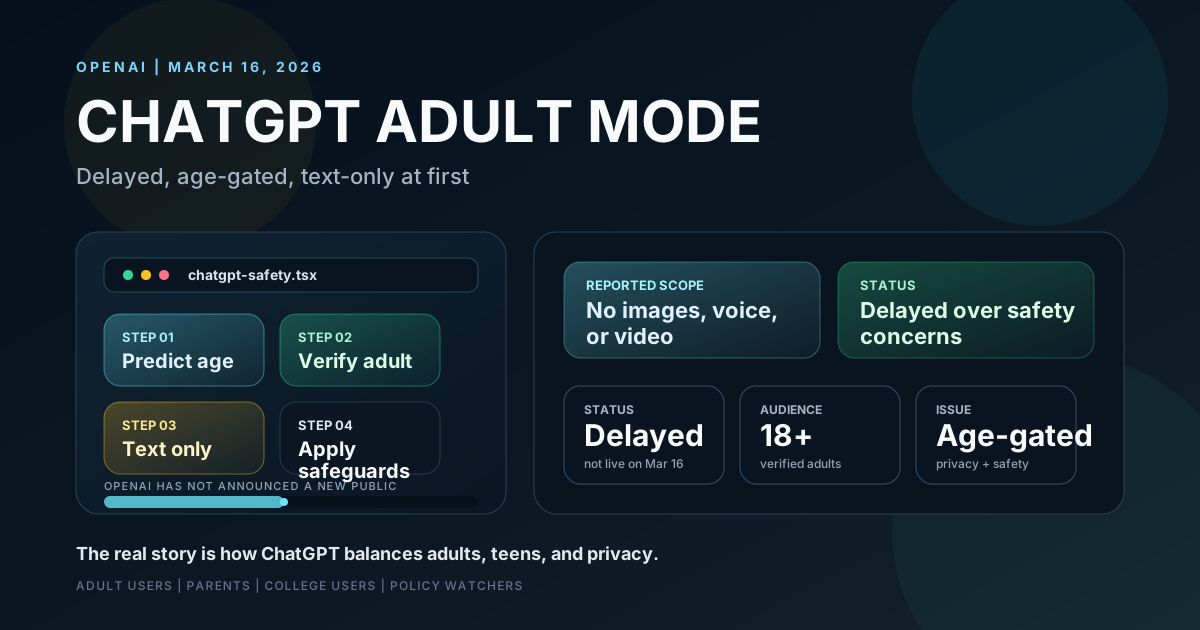
ChatGPT Adult Mode: Is It Live Yet? (Status Explained)
ChatGPT adult mode is still delayed — OpenAI's official status, what the feature would allow, why it was pushed back, and answers for parents.
LLM Engineering
GPT-5.4 for Agents: Computer Use, MCP Tool Calls, and Real Pricing
GPT-5.4's native computer use and MCP tool calls are the real upgrade for agents. What holds up in a loop, what the 1M context costs, and how Pro compares.
Keep reading
Get new posts on AI, Claude Code & LLMs
New deep-dives on AI engineering, Claude Code, and developer tooling — follow along however you prefer.
About the Author

Software engineer writing about AI, Claude Code, LLMs, OpenAI, Anthropic, and developer tooling. 5+ years building production systems at Expedia Group, Tekion, and BYJU'S.